
Keep the soil where it is
Slope & Channel Erosion Control in Indianapolis, IN
Blankets, hydromulch and seed for the slopes and drainage paths that wash out first.
- Free walk-through and an itemized written quote
- Seed mix matched to sun, shade and how the lawn gets used
- A watering schedule left with every new seeding
Where Flat Ground Still Erodes
Slope and channel erosion control in Indianapolis is less about mountainsides and more about the places water concentrates: the back slope of a detention pond, the swale between two houses, a roadside ditch, a creek bank in a backyard, or the cut bank behind a new walkout basement. The city's till plain is mostly flat, but the White River and its roughly 35 tributary streams, among them Eagle Creek, Fall Creek, Pleasant Run and Pogue's Run, have cut valleys and ravines, and every development adds new grades. When a thunderstorm drops an inch of rain in an hour, all of that water heads for the low line, and bare soil goes with it.
Matching the material to the problem
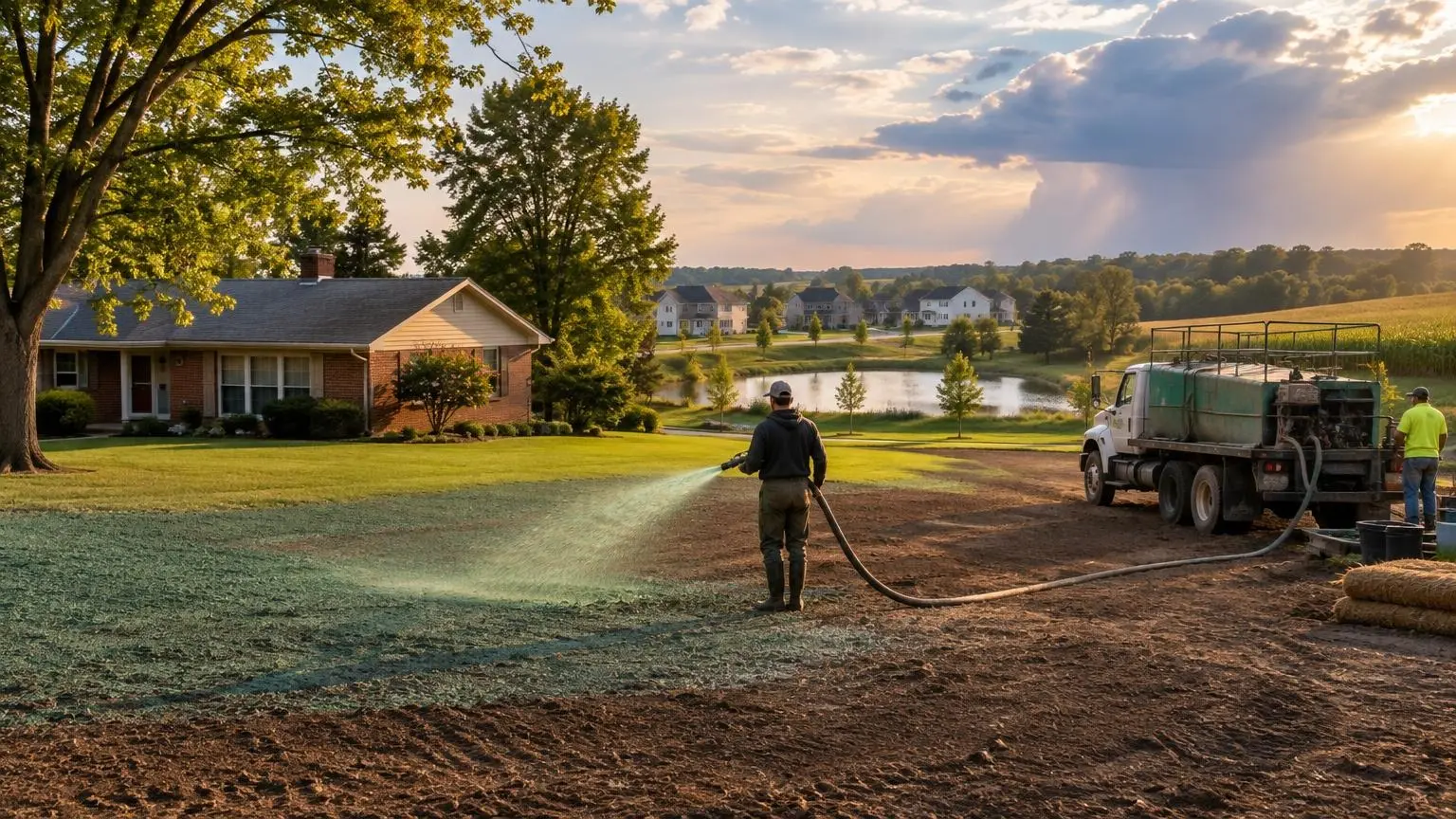
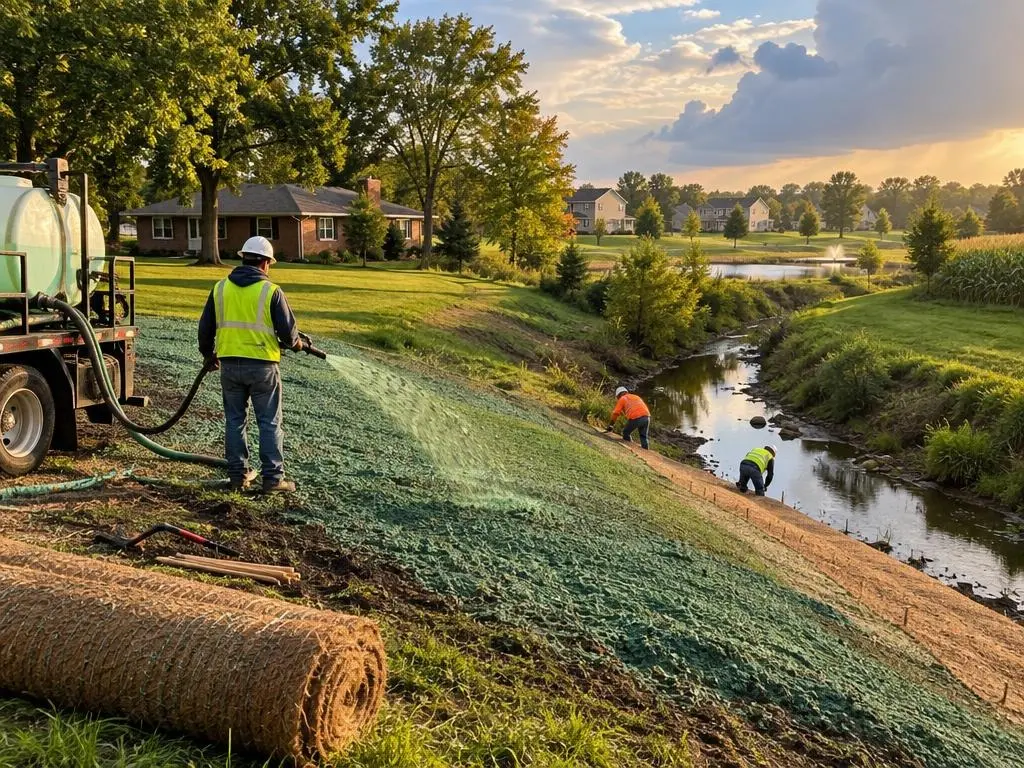
Gentle slopes with sheet flow can often be held with a heavy hydromulch application and a strong tackifier. Steeper slopes, generally anything you would hesitate to mow, need more: a bonded fiber matrix, which sprays on and dries into a continuous, porous mat, or a rolled erosion control blanket stapled to the ground. In swales and ditches where water runs in a channel, blankets are usually the right answer, because sprayed mulch can lift once flow gets moving. Straw blankets break down over a season or two as the grass takes over. Straw and coconut blends and pure coir last longer for channels and steeper ground.
Why our soils need help
The silty surface soils over glacial till that dominate central Indiana are productive farmland, but silt is among the easiest soil particles for water to pick up and carry. The dense till underneath lets water through slowly, so on a slope the surface layer saturates and runoff starts sooner than it would on sandy ground. Spring is the hardest season: May is typically the wettest month, March and April bring big temperature swings, and new seed is slow to establish in cool soil. Slope stabilization that holds through one spring usually holds for good once the grass roots in. That is why we prefer to finish slope work in late summer or early fall, giving roots a full fall and the following spring to grow before the next round of heavy storms.
Seed is the long-term fix
Blankets and mulch are temporary. What holds a slope for decades is a dense stand of grass with deep roots. We seed under every blanket and into every hydromulch application, choosing mixes for the site: turf-type grasses where the slope will be mowed, lower-growing or native-leaning mixes on banks that will be left alone. On creek banks and pond edges we pick species that tolerate both wet feet and dry spells.
Permitted sites and backyard problems
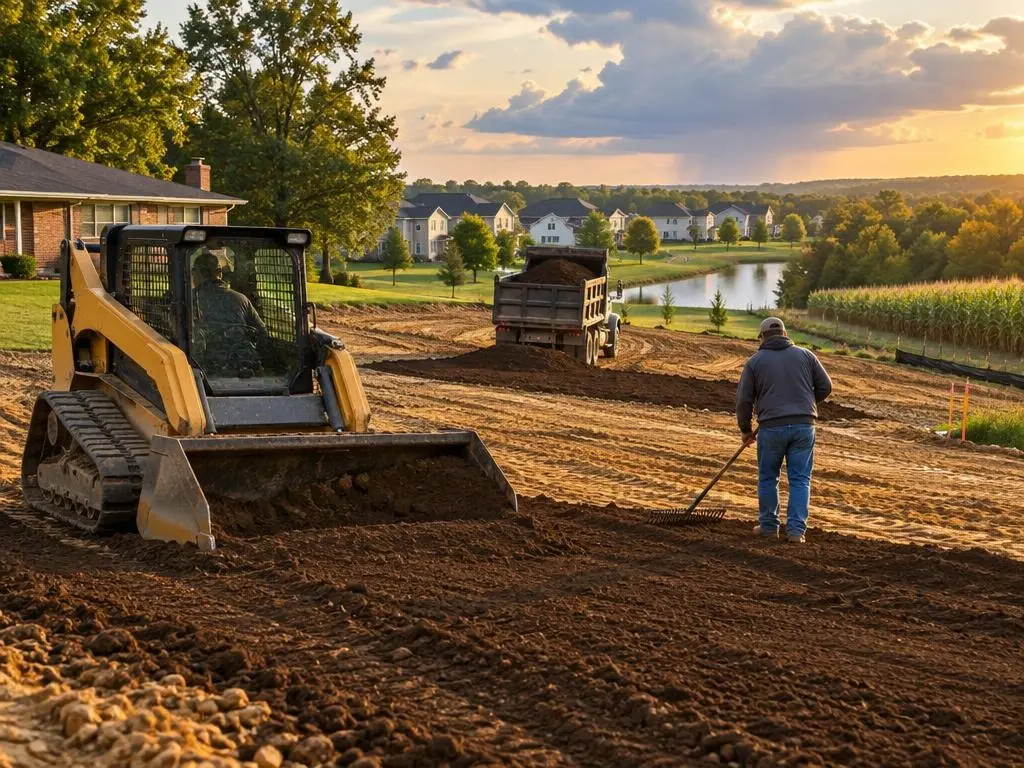
On construction sites the stormwater pollution prevention plan usually specifies blanket types and locations, and we install to it. Indiana's Construction Stormwater General Permit is aimed squarely at sediment, so the slopes and channels on a permitted site get inspected. Homeowners call us for different reasons: a backyard bank that drops a little more soil into the creek every storm, a swale that has cut a gully down to clay, or a hillside the builder seeded once and never came back to. The fix is the same idea at a smaller scale. We reshape the damaged area, add soil where it has been lost, seed it, and cover it with the right blanket or mulch.
Installing blankets correctly
Most blanket failures come from installation, not the product. The top edge has to be buried in a trench, the rolls run downslope on slopes and with the flow in channels, overlaps shingled so water rides over the seams, and staples set closely enough that the blanket stays in full contact with the soil. If water gets under a blanket, it tunnels and the slope fails anyway. We staple to the manufacturer's pattern and check channel installations after the first big rain. Where a blanket ends at a pipe outlet or a road culvert, we add extra staples and an anchor trench, since those transitions are where water hits hardest.
Signs a slope needs attention
Small rills running downhill after a storm, a fan of silt at the bottom of a bank, grass that never fills in on one face, exposed roots along a creek edge, or a swale cutting deeper each year all mean water is winning. Catching them early is cheaper: a reseeded and blanketed slope costs far less than rebuilding one after a gully has formed. If you are not sure whether a problem is serious, send us photos after the next rain and we will tell you what we think before scheduling a visit.
Erosion control services we offer
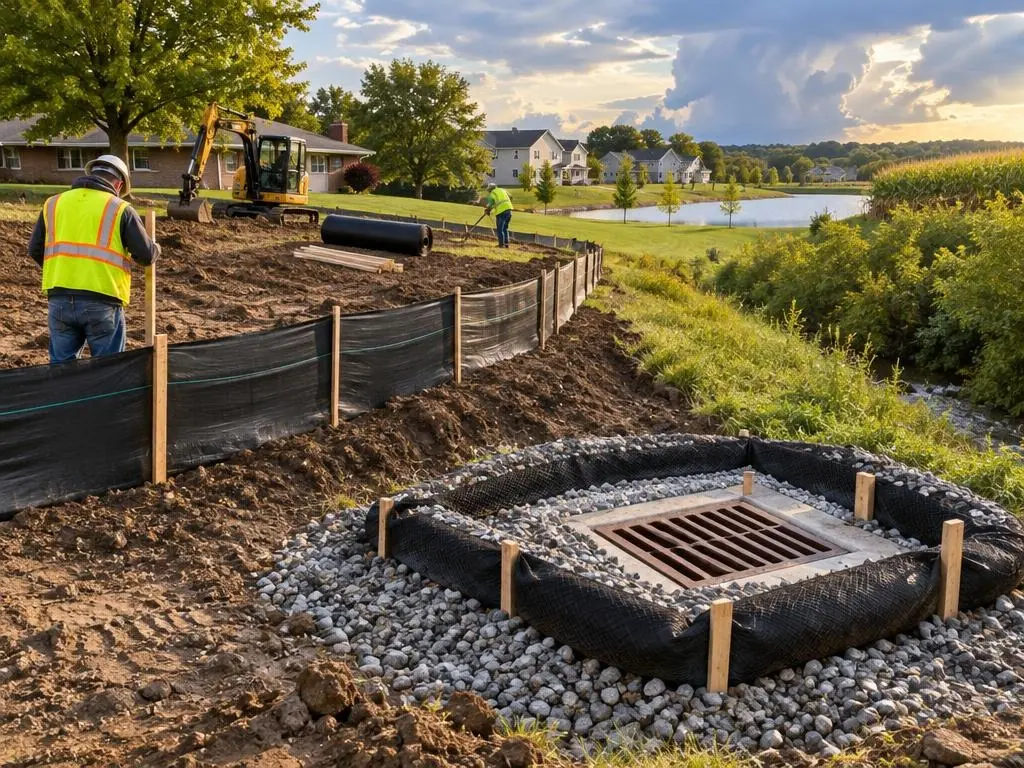
We handle residential slopes and swales, builder and commercial basins, ditches and right-of-way, and creek and pond banks. If your site also needs sediment controls at the bottom of the slope, our silt fence crew handles that as part of the same job. Get a free estimate
Erosion Control Options
Materials chosen for slope, flow and how long the site needs protection.
Straw erosion control blankets
Biodegradable straw blankets for moderate slopes and light channel flow.
Straw-coconut and coir blankets
Longer-lasting blankets for steeper ground and swales that carry water.
Hydromulch and hydro mulching
Wood or paper fiber mulch with tackifier sprayed over seed on gentle slopes.
Bonded fiber matrix
A sprayed mat that dries into a continuous cover for slopes too steep for standard mulch.
Swale and ditch stabilization
Reshaping, seeding and blanketing channels where water concentrates.
Creek and pond bank seeding
Seed mixes for wet edges and banks, held with blankets or mulch.
Published Costs for Erosion Control Materials
| Item | Published range |
|---|---|
| A state DOT's 2025 bid rates: sprayed wood-fiber mulch, per 1,000 square feet | $98 |
| Same list: straw-coconut erosion blanket, per 1,000 square feet | $468 |
| Same list: all-coir erosion blanket, per 1,000 square feet | $532 |
| Steep-slope surcharge on hydroseeding, per sq ft (HomeGuide) | $0.05 to $0.10 |
| Bonded fiber matrix | Quoted once we see the slope |
Rate-schedule figures are installed unit prices published by a state transportation department in 2025, not a local quote. Slope length, channel flow, access and seed choice change the work. You pay the figure written on the quote you approve.
From Washout to Stable Slope
1. Read the site
We trace where water comes from, where it goes and how steep the ground is.
2. Repair
Gullies filled, slopes reshaped and lost soil replaced.
3. Seed
A mix chosen for the slope's use, sun and moisture.
4. Cover
Hydromulch, bonded fiber matrix or blankets installed to the slope and flow.
5. Check
We look at channel and steep-slope work after the first heavy rain.
Why Choose Us for Slope & Channel Erosion Control
Right material, not the cheapest
Channels get blankets and steep banks get BFM or blankets, not just extra mulch.
Careful stapling
Trenched tops, shingled overlaps and full soil contact.
Seed under everything
Every cover goes over seed, so the slope ends up held by roots.
Slope & Channel Erosion Control Questions
On an Indianapolis slope, do I need hydromulch or bonded fiber matrix?
Hydromulch is fiber mulch with tackifier, good for gentle slopes. Bonded fiber matrix carries more binder and fiber and cures into a tough, water-permeable crust that holds on steeper ground with no stapling.
Do I need erosion control blankets in a swale?
Usually yes. Once water flows in a channel it can lift sprayed mulch, while a stapled blanket holds seed and soil until the grass roots in.
How long do straw blankets last?
Straw blankets are meant to break down over roughly a season or two as the grass establishes. Coir and straw-coconut blankets last longer for channels and steep slopes.
Can you fix a backyard creek bank that keeps eroding?
Often, by reshaping the bank, replacing lost soil, seeding and covering it with a blanket. Work in or along a stream can need state or federal permits, so we check that before any work below the top of the bank.
Will grass grow through an erosion control blanket?
Yes. The blanket is open enough for seedlings to grow through, and the netting is buried in the turf as it thickens.
Slope & Channel Erosion Control Service Areas
- Hydroseeding in Indianapolis, IN
- Hydroseeding in Carmel, IN
- Hydroseeding in Fishers, IN
- Hydroseeding in Noblesville, IN
- Hydroseeding in Westfield, IN
- Hydroseeding in Zionsville, IN
- Hydroseeding in Greenwood, IN
- Hydroseeding in Brownsburg, IN
- Hydroseeding in Plainfield, IN
- Hydroseeding in Avon, IN
- Hydroseeding in Franklin, IN
- Hydroseeding in Greenfield, IN
- Hydroseeding in Whitestown, IN
- Hydroseeding in Lawrence, IN
- Hydroseeding in Speedway, IN
- Hydroseeding in Cicero, IN
- Hydroseeding in Mooresville, IN
- Hydroseeding in Danville, IN
- Hydroseeding in Pendleton, IN
- Hydroseeding in Martinsville, IN
- Hydroseeding in Beech Grove, IN
- Hydroseeding in Lebanon, IN
Get a Slope & Channel Erosion Control Estimate
Free site visits for slopes, swales and ditches.