
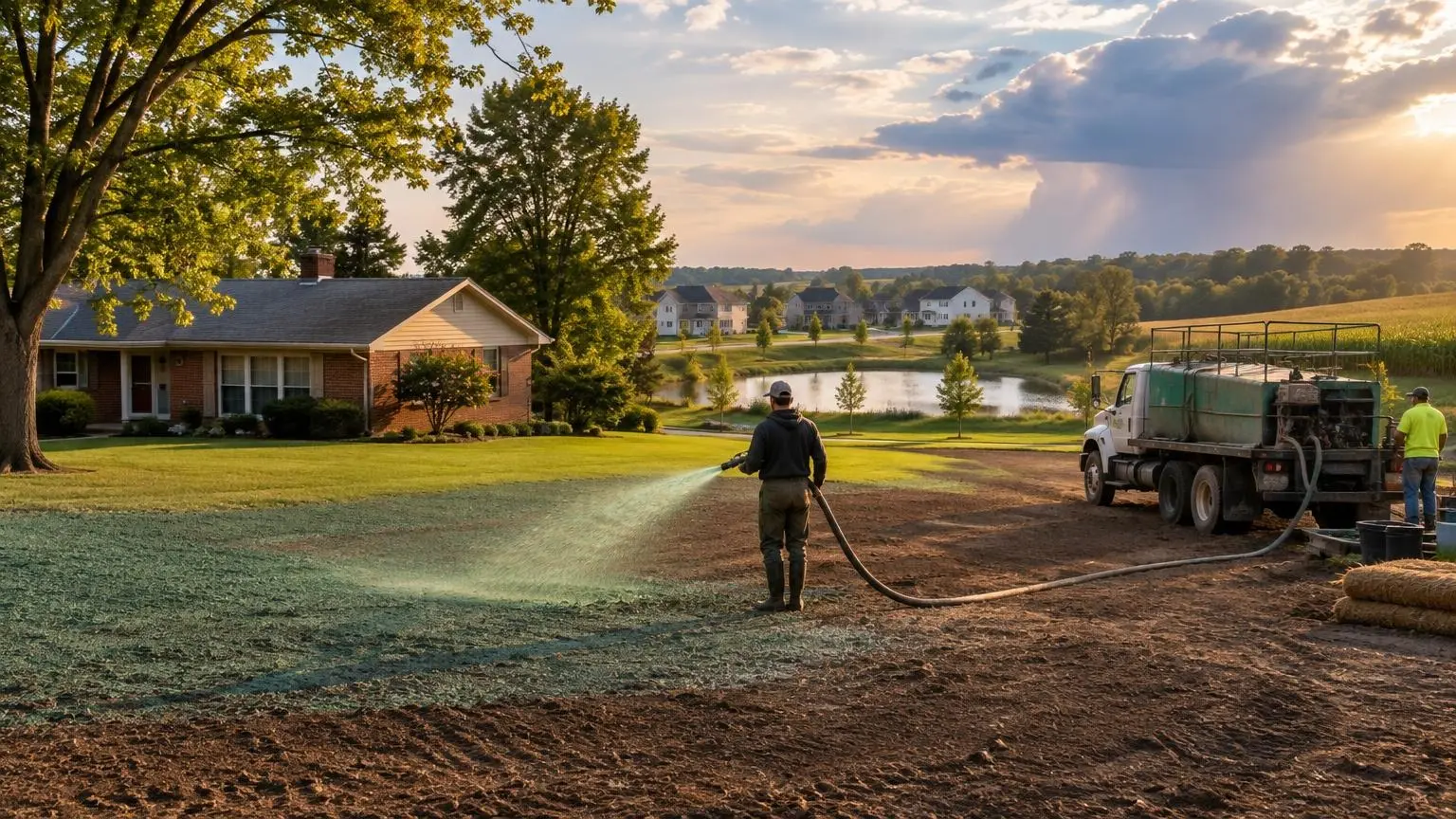
Central Indiana seeding crews
Hydroseeding in Indianapolis, IN
Seed, mulch and tackifier sprayed in one pass on till plain soil, timed for central Indiana's seeding windows.
- Free walk-through and an itemized written quote
- Seed mix matched to sun, shade and how the lawn gets used
- A watering schedule left with every new seeding
Growing Grass Where the Glaciers Left Clay
Hydroseeding in Indianapolis is a one-pass job: a truck-mounted tank mixes seed, fertilizer, tackifier and a wood or paper fiber mulch into a slurry, and a hose or cannon lays it over prepared soil. The mulch shades the seed and holds moisture, and the tackifier glues it to the ground so a summer storm does not carry it into the gutter. We use it for new lawn installation on bare yards, for builder lots and commercial sites, and for slopes, swales and ditches where loose seed and straw will not stay put. Most of our hydroseeding services start the same way: a walk around the property, a look at how water moves across it, and a written estimate.
Ground that holds water
Indianapolis sits on what geologists call a till plain. The Laurentide ice sheet sat on the area's southern margin, and its advance and retreat left a flat or gently sloping landscape with elevations that only range from about 650 to 900 feet across the whole city. That sounds easy for lawn seeding, and in one way it is: few yards here are steep. The catch is the soil. The Miami series, Indiana's state soil, formed in up to 18 inches of silty loess over loamy glacial till, and water moves slowly or very slowly once it reaches the dense till underneath. Somewhat poorly drained soils like Crosby can carry a perched water table within a couple of feet of the surface in winter and spring. On ground like that, seedlings in a low spot drown before they ever root. Getting the finish grade right matters more here than the brand of seed.
Rain arrives in bursts
The city averages roughly 42 inches of rain annually, with thunderstorms delivering the bulk of it. May is usually the wettest month at about 5 inches, with June and July close behind, and the area sees around 20 thunderstorm days a year. A downpour on freshly graded silt loam moves fine soil even on a 2 percent grade. Hand-broadcast seed floats off with it, and straw blows into the neighbor's yard. Hydromulch bonds to the surface and gives the seed a damp, shaded bed through the first two weeks, which is why erosion control contractors and lawn crews both lean on it for bare ground.
Choosing between sod, spray and spreader
A sod lawn is green on day one, which makes it the right call for a small front yard you need finished for a closing. It also costs the most per square foot, it has to be laid on a carefully prepared base, and it is heavy to move into tight backyards. Dry seeding with a spreader is the cheapest, but the seed sits exposed, birds pick at it, and the University of Nebraska Extension notes that dry-seeded grass usually takes two to three weeks to show, compared with five to seven days for hydroseed. That same Extension article places hydro seeding in the middle on price: slightly above dry seed, and usually under sod. For a hydroseed lawn on a larger lot, or anywhere the ground slopes toward a drain, the sprayed mulch is usually the better value.
When to seed in central Indiana
Our climate is humid continental with four distinct seasons, and the lawns that do well are cool-season grasses such as tall fescue, Kentucky bluegrass and perennial ryegrass. Purdue Extension puts the strongest seeding window at August 15 to September 15 in the northern half of Indiana and September 1 to 30 in the southern half. Indianapolis sits near the middle, so we aim for late August through September for new lawns. Spring seeding works, and builders often need it, but Purdue points out the problems: crabgrass sprouts alongside the new grass, soil warms slowly, and wet spring ground is hard to prepare. Midsummer is the hardest time. Highs reach 90 degrees on about 18 days in a typical year, and young seedlings need water several times a day to get through it. Dormant seeding from late November into March is an option on some sites, letting freeze and thaw work the seed into the soil.
Builders and the state permit
Indiana's Construction Stormwater General Permit, run by IDEM, covers clearing, grading and excavation that disturb an acre or more of land. It also reaches smaller parcels when they belong to a bigger development or sale that will disturb that much in total. A subdivision lot can fall under it even though the house itself sits on a quarter acre. The permit requires a stormwater pollution prevention plan, and its aim is to keep sediment from eroding soil out of streams. Since May 1, 2025, Indiana law has barred local ordinances from being stricter than that permit. On construction ground we set silt fence, protect storm inlets and staple down erosion control blankets where the plan calls for them, then hydroseed to get permanent cover established.
What we see most often
Across the metro, the same few problems come up again and again. New subdivisions on former crop ground get rough-graded, seeded once in a hurry, and left with clay at the surface. Older suburban neighborhoods inside the county, part of the nearly 100,000 housing units built in Marion County between 1950 and 1970, have lawns thinned by decades of shade from maples and oaks. Yards along the creeks that feed the White River have banks and swales that lose a little soil every storm. And builder lots need silt fence, inlet protection and fast cover to satisfy a stormwater plan. Each calls for a different mix of grading, seed, mulch and controls, which is why we price after a site visit rather than by phone.
After we spray
New seed needs the surface kept damp, not soaked. Extension guidance calls for light watering two or more times a day during hot stretches until the seedlings are established, then deeper and less frequent watering as the grass fills in. Plan on the first mow roughly a month to six weeks out, when the blades stand a few inches tall. Until that first cut, keep kids, dogs and mowers off the new turf. We leave a written schedule with every job and are a phone call away if a storm washes a corner or a spot comes in thin.
Why Homeowners Call Hydroseeding Indianapolis
Grade before seed
On slow-draining till we fix low spots and set drainage first, because seed cannot outgrow standing water.
Timed to Purdue's windows
We tell you when late summer is the better choice and what spring or dormant seeding will need to work.
Controls that match the plan
Silt fence, inlet protection and blankets are placed to the site's stormwater plan, not guessed at.
Line-item estimates
Prep, topsoil, seed, mulch and erosion control are broken out one by one, so no cost is buried in a lump sum.
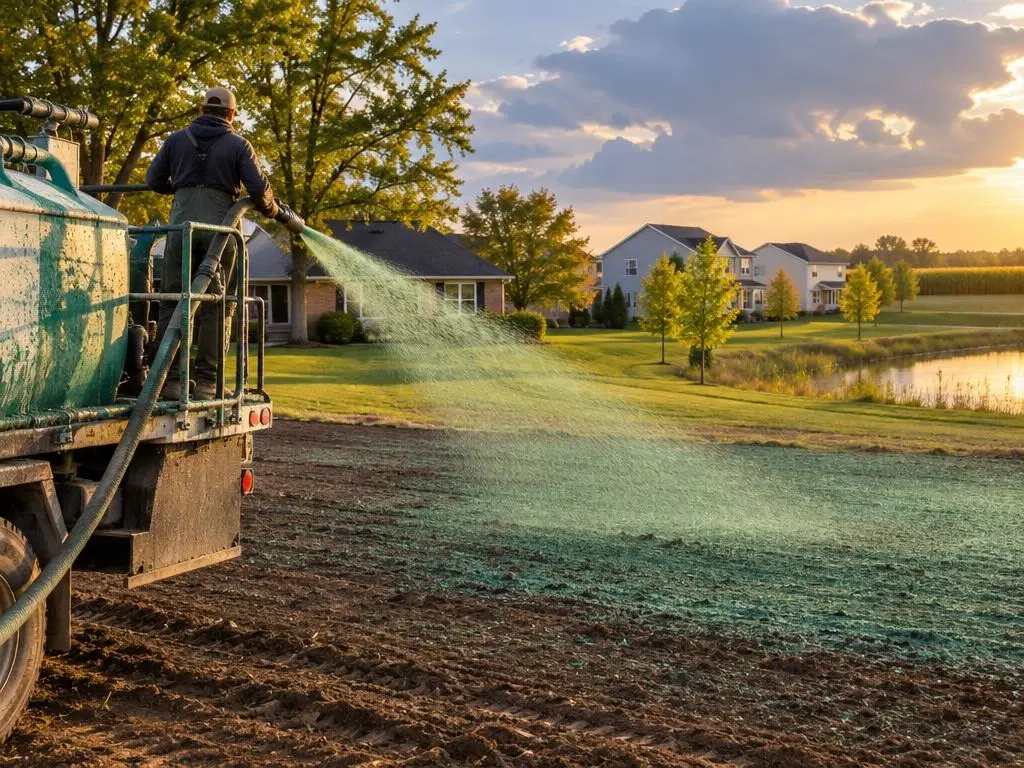
Neighborhoods, Suburbs and County Seats We Cover
Our crews work across Marion County, from older streetcar neighborhoods to the farm ground still left inside the city limits, and out into the surrounding counties. North of the city, Carmel, Fishers, Noblesville, Westfield and Cicero mix fast-growing subdivisions with reservoir shorelines at Geist and Morse. Zionsville, Whitestown and Lebanon in Boone County turn crop ground into neighborhoods and industrial parks. West of town, Brownsburg, Avon, Plainfield and Danville follow the White Lick Creek valleys, with large warehouse sites near the airport. To the south, Greenwood, Franklin, Mooresville and Martinsville sit closer to creek bottoms and the hillier ground where the glaciers stopped. East and northeast, Lawrence, Greenfield and Pendleton follow Fall Creek and Brandywine Creek, while Speedway and Beech Grove are compact, older towns where lawn repair matters more than acreage. Pick a town below for its soils, creeks and the seeding questions we hear there.
- Hydroseeding in Indianapolis, IN
- Hydroseeding in Carmel, IN
- Hydroseeding in Fishers, IN
- Hydroseeding in Noblesville, IN
- Hydroseeding in Westfield, IN
- Hydroseeding in Zionsville, IN
- Hydroseeding in Greenwood, IN
- Hydroseeding in Brownsburg, IN
- Hydroseeding in Plainfield, IN
- Hydroseeding in Avon, IN
- Hydroseeding in Franklin, IN
- Hydroseeding in Greenfield, IN
- Hydroseeding in Whitestown, IN
- Hydroseeding in Lawrence, IN
- Hydroseeding in Speedway, IN
- Hydroseeding in Cicero, IN
- Hydroseeding in Mooresville, IN
- Hydroseeding in Danville, IN
- Hydroseeding in Pendleton, IN
- Hydroseeding in Martinsville, IN
- Hydroseeding in Beech Grove, IN
- Hydroseeding in Lebanon, IN
Our Services
Lawn, construction, slope, sediment, grading and repair work for Indianapolis homeowners, builders and site managers.
New Lawn Hydroseeding
Hydroseed lawns for bare new-build yards, rebuilt backyards and any lawn installation starting from soil.
Learn more →Builder & Commercial Hydroseeding
Large-area seeding for subdivisions, commercial pads, detention basins and right-of-way after grading.
Learn more →Slope & Channel Erosion Control
Slope and channel protection with hydromulch, bonded fiber matrix or stapled blankets on swales, ditches and creek banks.
Learn more →Silt Fence & Inlet Protection
Silt fence installation, storm drain inlet protection and sediment control for permitted job sites and small lots.
Learn more →Grading, Topsoil & Dirt Work
Yard grading, land grading, topsoil spreading and the other dirt work a lot needs before seed goes down.
Learn more →Lawn Renovation & Overseeding
Lawn repair, overseeding and renovation for thin, patchy or worn-out turf.
Learn more →
Common Questions
Is October too late to hydroseed in Indianapolis?
Early October can still work for cool-season grass if the seed goes down in the first week or two and you keep it watered, but it is past Purdue's preferred September window and young grass will go into winter thin. By late October we usually recommend waiting for a dormant seeding after the ground cools in late November, or for the next spring or late-summer window. If the ground is bare and will erode, we can mulch and stabilize it now and seed later.
What grass seed works for lawns in central Indiana?
Cool-season grasses suit our climate. Tall fescue handles heat and wear well, Kentucky bluegrass spreads and repairs itself in full sun, and perennial ryegrass sprouts quickly and is often blended in. For shade under mature trees we add fine fescues. We choose the mix after seeing the sun, shade and traffic on your lot.
What is the average cost to hydroseed?
For residential hydroseeding, HomeGuide's national figures come to $0.12 to $0.35 per sq ft, Angi's to $0.07 to $0.26, and LawnStarter notes minimum job fees of $300 to $500. Grading, topsoil and slopes add to that. After we see the yard you get a written quote, and we hold to that number when the job is done.
Is hydroseeding better than sod for an Indianapolis yard?
It depends on size and timing. Sod is instant and suits small areas you need finished right away. Hydroseed costs much less per square foot, roots into your own soil from the start, and holds better on slopes and drainage paths, but it takes weeks to fill in.
How long until a hydroseeded lawn is green?
Under good conditions the first sprouts show in about five to seven days, and the lawn looks green within a few weeks. Thick, mowable turf usually takes four to six weeks, longer in cool spring weather.
Do I need a stormwater permit before seeding a construction lot?
Indiana's Construction Stormwater General Permit covers land disturbance of one acre or more, and it can also apply to a smaller lot inside a bigger planned development. Homeowners re-seeding an existing yard generally do not need it. If you are a builder or developer, we work from your site's erosion control plan.
How often should I water new hydroseed?
Keep the mulch surface damp. In warm weather that usually means two or three light waterings a day until the seedlings are up and filling in, then fewer, deeper waterings. We leave a written schedule for your lawn.
Book a Free Site Visit in Indianapolis
We look at the grade, drainage and shade, then send a written estimate.